


CSF Abroad: Our First Week in Armenia!
- edhuxt
- Apr 16
- 2 min read

by Charlotte Groombridge
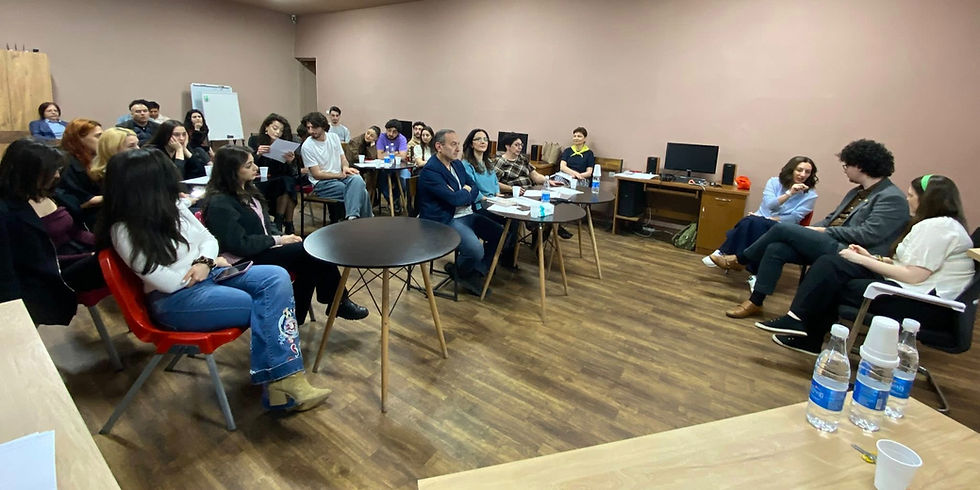
One week already spent in wonderful Armenia (time really does fly when you’re three hours ahead!), and with just under a month to go until the preview of Macbeth (don’t we just love a tight deadline…) and our flight home (booo!) we thought we would share some of our thoughts and reflections on not only staging Shakespeare outside of CSF, but also in a language completely alien to us.
Firstly, we are endlessly grateful to the Yerevan Chamber Theatre and to the Armenian Shakespeare Association for endeavouring to make this project happen. So much trust has been placed in our ability to create a show that will do justice to their resident actors, appeal to the loyal audience the Chamber Theatre has built up over the years, whilst also staying true to the timeless themes of one of the Bard’s greatest works. And in just five weeks!
It’s doubtful that there are any British actors who don’t know the plot of Macbeth, and, if asked, most could defend a particular version which they believe to be the definitive performance (our personal favourite being Fassbender’s incredible film from 2015). However, here in Yerevan we are finding a refreshing lack of knowledge of the key characters, their history, their relationships, an unfamiliarity of which scenes are considered to be “the most important”, which speeches and lines are the “famous ones”, and an unawareness of the complex symbolism which runs through the themes of the play.
This gives us a singularly rare opportunity to direct Macbeth through almost completely fresh eyes. Armenian actors are not bringing any preconceived notions of what the show has to be, but instead are building from the text up, allowing what is on the page to guide their emotions and interactions. Watching Ziroyan deliver the “tomorrow, and tomorrow and tomorrow” speech for the first time was a truly magical experience.
It’s an approach which we normally only get the chance to participate in when dealing with our self-written pieces or with modern texts which most of the cast are not familiar with, and never did we think we could experience it with Shakespeare, whose plays have become a cultural language in the UK.
This has necessitated a few more rehearsals around the table in the first few days (something we rarely have the need for in CSF), yet the process hasn’t felt slow or stagnant, far from it. The talent and dedication of this cast cannot be understated, but this also highlights the universality of Shakespeare. Whether in English or Armenian, he never fails to make himself understood.


The need for Samagra ID download continues to grow because people want quick digital access to their identification details for documentation, verification, and personal use. Whether someone needs it for a school-related form, a government process, or simply to keep a record for future use, having a downloadable version makes the information much easier to manage. However, many users struggle because they are unsure where to begin or what details they need to complete the process. A clear introduction to this topic should explain why downloading the ID is important and how it fits into practical day-to-day requirements. This makes the subject highly useful and relevant.