


“Speak Plain and to the Purpose” - Using Shakespearean Translations

written by Charlotte Groombridge

Macbeth arguably contains some of Shakespeare’s most famous lines and speeches. For who among us doesn’t own an “Out, damned spot!” or “Tomorrow and tomorrow and tomorrow” fridge magnet? If you don’t, please consider buying one at this summer’s performances… However, most of the time the only real considerations when using Shakespeare’s works is exactly how much of the text will be gone, and precisely where you are going to make the cuts. Not so when that work has suddenly become a translation.
‘Suddenly’ is an egregious term to use, as it is only through the tireless work of our brilliant translator, Jasmine Seymour, that we have this script at all. She has brilliantly tweaked Hovhannes Khan Maseyan’s translation from the early twentieth century, bringing it right up to date.
And Shakespeare doesn’t make it easy. How can you possibly translate “Macbeth does murder sleep” in a way which preserves both the meaning and the poetry of the piece?
This, in a nutshell, is one of the challenges we have been relishing during this process. As a whole, the play is still Macbeth. The themes, the characters, the story beats remain unchanged. The interesting differences start to emerge with a closer look at the text.
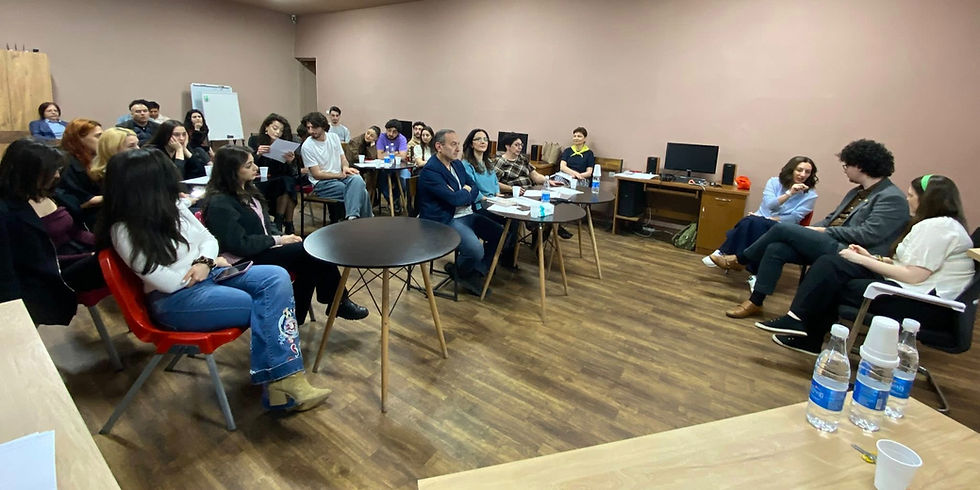
English is a fascinating language. We often take it for granted how fluid it can be, with many words holding a double or hidden meaning, something which is utilised heavily by Shakespeare. An early rehearsal was somewhat derailed by Elliot trying to explain the significance he places on the word play meaning both “theatrical performance” and “having fun” in English, when they are two distinct words in Armenian.
When the First Witch finishes a monologue with “I’ll do, I’ll do, I’ll do”, the double meaning to English speakers is clear, with “do” being a stand-in for a far less PG phrase. In our text, that meaning is now lost. A decision, then, has to be made. Do we try to bring that back with the acting, or play the line in a different way?
But it’s not all about what has been ‘lost’. In Armenian, there is a distinction between the singular and plural “you”. Singular for one person, plural for a group, and, even more interestingly, they use plural for addressing royalty. This means that when Macduff chooses not to use the plural form when addressing a newly crowned Macbeth, it sends a clear message that Macduff views him not as a rightful King, but a murderous tyrant.
Jasmine has often told us that one of the hardest lines for her to translate was “Tomorrow and tomorrow and tomorrow”, for the word tomorrow, վաղը (pronounced ‘vagh-hy’), is only two syllables in Armenian. Her ingenious solution? Making the line “Tomorrow and tomorrow and yet tomorrow again”. Same meaning, same metre, same sense of poetry? We certainly think so!
So, any time you find Shakespeare a little too difficult to follow, just be thankful you’re not trying to follow it in a different language!


Comments